
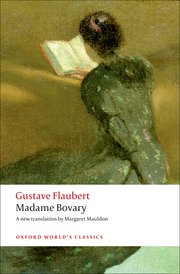
Mauldon Translation
I read Madame Bovary in high school, in French, which is to say, I didn’t read it. What I did was spend many hours with a French-to-English dictionary. I was eager to read it as an adult, this time in English.
The classic novel is a slow story by modern standards. Country girl Emma, daughter of a pig farmer, is married off to a country doctor, Charles, where she achieves a comfortable life. But she dreams of luxury and fine clothing, food and furniture, dancing all night, and above all, she dreams of romance. Charles is boring as dirt.
Bored to death, she embarks upon a series of affairs, during which she spends her husband’s money extravagantly, leading inevitably to disaster for them both. The novel was scandalous in its time (1856), of course.
It is difficult to understand the psychology of country folks in Normandy a hundred and fifty years ago. One of the enjoyments of the novel is the insight Flaubert provides into that, although it is impossible for me to know, without considerable research that I am not willing to do, what parts are real and what parts are fantasy.
For example, Charles has to be the most dimwitted cuckold in all of history. Even a dog could see that Emma was fooling around. Could the taboos against adultery in country life have been so rigid as to make it unthinkable and invisible? I doubt it. Adultery has been going on for a very long time in all civilizations, in all classes, in all species. So Charles’s ignorance seems improbable. Toward the end, when the evidence is overwhelming, he sort of chooses to not understand, which is slightly more believable.
And what of Emma? Could there really be such an empty-headed, unsocialized, untutored woman so possessed of childhood fantasies? Maybe. Women were, as a cultural practice, untutored and badly socialized, and the only child of a pig farmer would have had limited opportunity for psychological development. Still, it is hard to believe that as an adult Emma could be so utterly bored and self-centered, especially since she is presented as articulate, literate, witty, and talented in music, sewing, and finance. So she is not believable either.
Add those two ciphers together and you get… nothing believable. The novel mechanically plods to its inexorable conclusion but I never was engaged with the characters.
The story is presented with mud-on-the-boots realism, so there is plenty of insight into everyday life, which I appreciated in the well-annotated Oxford edition that explained almost every reference to obscure practices, foods, religious ceremonies, medical procedures and news articles. All that helped in getting a clear glimpse into lives in another century.
Mauldon’s translation, while perhaps not as lyrical as Lydia Davis’s more celebrated one, is good on rendering the sweat and roughness of everyday life in simple and coarse terms, also contributing to a compelling sense of seeing life as lived on the ground in that time and place. I enjoyed that quite a bit.
Finally, I admired Flaubert’s craftsmanship. It is often said that he invented the modern novel and that could be right. He supposedly did invent the narrative technique of free indirect discourse (FID) wherein a third-person-close narrator temporarily dips into first-person voice to express the mind of a character.
I think the first official use of FID in the modern novel in 1856, occurs on page 11, describing Charles’s boyhood. He’s walking along the banks of the river, experiencing the great outdoors:
“Opposite, above the rooftops, he could see the vast, pure sky, and the red sun setting. How wonderful to be in the country!”
The first sentence is from the third-person narrator, but who gives voice to the second sentence? It’s a blend of narrator and Charles himself, and there it is, the historical moment of the invention of FID.
I also appreciated Flaubert’s detailed descriptions of the environment.
“The ballroom was stifling; the lamps were growing dim. People were moving out into the billiard room. A servant climbed onto a chair and broke a couple of panes; at the sound of the shattering glass, Madame Bovary looked round and saw, in the garden, pressed against the window panes, the faces of peasants, staring in.” (p. 47)
I can experience that. It’s detailed, sensory writing, enjoyable and admirable.
Overall then, the book has many fine qualities that make it a deserved classic, even if strong character and plot are not among them.
 When I learned that world-famous linguist and political commentator Noam Chomsky would teach a class at the University of Arizona, I signed up. A lot of people from the northeast come to Tucson for the winter, but most of them don’t come directly from MIT to teach a university course. Whatever his reasons, I was glad to take advantage.
 So what is his grievance? He believes, with good reason, that capitalism inevitably leads to exploitation of workers and ultimately to government plutocracy, rule by the rich, a situation we have arrived at in America. He has deep roots in Marxism, but he’s not “a Marxist,” if there are even any of those left. That set of ideas has its own internal contradictions, such as the labor theory of value, a foundational idea based entirely on a semantic ambiguity. But we did read excerpts from Marx, Gramsci, and others. About half the assigned readings were quite valuable.
 I have been wriggling against the sci-fi label since I accidentally wrote my first sci-fi novel a decade ago. I didn’t mean to write sci-fi, but the story had an AI android in it. I don’t even like sci-fi.
 Could this be the genre slogan? “Use no oil!” Has a nice ring to it, I think – almost as good as a manifesto.
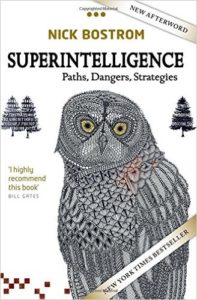 This briefing by Nick Bostrom on the dangers of artificial intelligence takes up a serious and legitimate question: Should we be more cautious as we go about trying to improve artificial intelligence? What if an AI became so smart it decided to take over the world? Silly? I think so. But it’s a question worth exploring, if only to dispel long-standing fear of the mythical “Frankenstein Syndrome.”
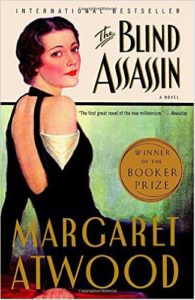 Margaret Atwood cut her writing teeth on poetry and it shows in her novel, The Blind Assassin, perhaps too much. Her phrases are carefully constructed, a virtue in any writer, but Atwood’s choices often stand out as slightly too clever, while not particularly insightful. As the book opens, the narrator’s sister, Laura, has died, and Iris, the sister, writes about her sister’s novel,
 If I had unlimited time and money, I would waste it on the University of Arizona’s annual conference on consciousness, called, optimistically, “The Science of Consciousness.” Of course there is no such science. One can (I can) argue that consciousness, being immaterial, is not even susceptible to scientific methods of inquiry.
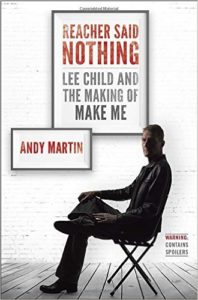 Andy Martin’s deconstruction of Lee Child’s twentieth, and hopefully last, Jack Reacher novel, Make Me, is at first glance an exercise in flamboyant grandstanding pretending to be hagiography. At least 80% of the book is filled with tangents not even remotely germane and peppered with mystifyingly irrelevant anecdotes. It is extremely annoying for that. But on closer reading, I think that’s all obfuscation, part of a near-fantastical feat of mental conjuring worthy of Jack Reacher calculating the trajectory of an incoming bullet.
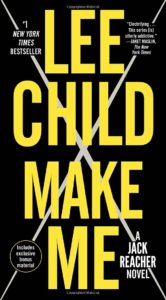 “Make me,” a schoolyard taunt, is the title of Lee Child’s 20th and possibly final Jack Reacher novel. The first one, “Killing Floor” came out a decade ago (1997) and the series has been on the top of the sales charts ever since. I wanted to figure out what the magic is. There has to be a secret sauce. But I found “Make Me” so bad as to be unintentionally funny, as if it were a deliberate parody of the tough-guy crime novel. But I don’t think it’s supposed to be a parody. I think it’s straight up.
 I think I’m recovered from my New York Pitch Conference, a week in the city trying to learn how to pitch a novel manuscript. I came back with a mission: to re-write my manuscript, incorporating all that I’d learned. Trouble was, I couldn’t face it, couldn’t even open the file. Maybe the manuscript was really no good. Was I capable of turning it inside out? Wouldn’t that ruin it? Did I have the creative spark to completely reconceptualize my hard-earned and carefully assembled story? Maybe I should forget the whole thing. And worse than that.
 But after a week my emotions settled down and I went through my notes from the conference. Some of the notes were impressions I had jotted after evening events in various “happy hour” settings, shouting over the din at people only two feet away. Every bar in the city was thronged with pre-holiday celebrators and in one Irish pub we were told we had to leave in thirty minutes because the whole bar was reserved for “a function.” The workshop instructor, who apparently knew his way around, marched us all like ducklings to another place on 38th street, smaller, louder, with no place to hang your coat.
 One was a woman from Ontario with a degree in film studies who had given a great pitch on the first day about King Tut’s girlfriend (historically accurate, apparently). She was small and cute, with a face that reminded me of a young Nicole Kidman. She was drinking Prosecco like a fish and she commented on how imaginative my beachball alien was. She said, “I wrote a really imaginative story too, not long ago. It’s about this guy who has a huge asshole, and gradually the asshole acquires a personality and becomes a character, and it talks and everything. So the guy develops a relationship with it and of course he ends up having sex with it.”
 At a loss how to proceed in that conversation, I switched my attention to a tall, thin Mexican-American guy with a grey ponytail. He had pitched a western theme set in the civil war era, that nobody could understand. He said he was giving that up and now wanted to retell the story of the birth of Jesus as a spaghetti western in the style of Tarantino.
 That night, I scrapped my beachball alien and wrote a new pitch involving chatbots circulating on the internet. Of course they go rogue. The instructor liked it. “Do that one,” he said. “Humor doesn’t sell.”
 King Tut’s Girlfriend received two requests. Other stories, incomprehensibly to me, also got multiple requests from the editors. These invariably involved stock superheroes and what seemed to me cliché sword and sandals adventures but what do I know? One sword-wielding hero had deer antlers growing out of his skull, so I guess that was something. Nothing for “High Plains Jesus.”